


Financial Mistakes Writers Make and What to Do Instead
by Miranda Marquit
After finishing journalism school, I started looking for work online.
I knew I wanted to stay home with my then-toddler, and my then-husband was working on his Ph.D., so it made sense. With my journalism background, I was able to start writing for a couple of websites, one of them a physics website.
However, it’s still possible to make money as a journalist online. There are plenty of websites that will pay for good writing and research skills. It’s not investigative journalism, but there’s some jobbing work you can do with those skills.
In fact, some of the financial websites I write for, like Bankrate and those owned by Lending Tree, have more vigorous fact-checking requirements than many newsrooms right now.
The Face of Journalism is Changing
For the most part, though, the face of it [journalism] is changing. We need journalism and accurate facts more than ever. We need trusted resources. The difficulty is getting through the changes to the landscape and being able to pay for it.
Journalism has, to some degree, always relied on the ability to make money. The days of “yellow” journalism more than 100 years ago were a prime example of sensationalism back then, and we see versions of it today.
It’s viable to be a writer these days, but you also need to understand that you might not get your start writing high-minded treatises or doing the type of investigative journalism you used to dream about. Instead, you might do other types of work to pay the bills and work on more in-depth and interest-driven pieces in your spare time.
How I “Fell Into” My Finance Writing Niche
My niche is finance. I sort of fell into it accidentally.
I was originally a science writer, doing work for a physics website and a little work for Discover magazine. I also wrote for early content farms.
One day, someone saw my work on a content farm and noticed its quality and consistency. She contacted me and asked if I’d write for a retirement company’s blog.
Blogging was just being introduced as a marketing strategy online, so it was a great opportunity. Pretty soon money just became my main focus. I used my skills to research money and my interview skills to talk to experts.
Today, not only have I learned about money, but I’m also considered a subject matter expert about money, particularly student loans, healthcare, small business, credit, beginning investing and family finances.

Miranda working at home.
Using Your Online Presence to Attract New Clients
Over time, I’ve built up a reputation for quality work, delivered on deadline. That’s helped a lot [in terms of getting more clients].
I also made it a point to create a modest presence on social media. I have LinkedIn, Twitter and Facebook profiles, as well as one on Instagram. I don’t do anything too crazy, but I’ve made a point to provide insightful posts and to share my clients’ work. While I don’t go out of my way to share everything I’ve published, I do try to share what I’ve written on social — and tag my clients when I do.
I also have a website. I do my best to post about once a week, and there are links to my various online author pages. I also make it easy to contact me with a page on my website. I also appear as a guest on podcasts when asked. In the past, I used to have my own podcast (I sold it last year), and it was a good way to raise my visibility, and drive people to my website.
Writers: Attend Conferences in Your Niche!
Finally, I make it a point to attend conferences in my niche. It allows me to meet potential clients and make connections. I also maintain a network of other freelancers and journalists and we share tips and recommend each other for gigs as needed. There are websites you can sign up for and get regular work and new clients.
I’m to the point right now, though, that mostly I have regular clients and the work is fairly steady. Occasionally, if it looks like something is slowing down, I’ll follow up with clients to ask if they have extra work. Often, they respond that they do have more work, or that there’s another department that needs extra help.
Content About Money Makes Money
The most lucrative assignments [for me] are those related to money. Content about money makes money.
In the personal finance niche, some of the most lucrative assignments are credit card and loan reviews because they also have the highest affiliate payouts. However, when a recession hits, affiliate income goes down — so those assignments are often put on hold.
You can also make decent money doing technical writing and white papers. Data-based writing also pays well. If you can look at survey data and use it to tell an interesting story, you can also make good money.
Finally, copywriting often pays well. If you can do copy for website landing pages as well as effective email marketing copy, you’re more likely to command higher rates.
The Top 3 Financial Mistakes Freelance Writers Make
One of the biggest mistakes is focusing too much on marketplace bidding websites.
There are websites that offer you the chance to connect with clients, but bidding websites take a lot of time and energy, and you end up undercutting yourself. You make a small amount of money for way too much effort.
Rather than spending too much time with low-paying bidding marketplaces, look at other types of sites that offer better leads.
The second big mistake is that too many writers base their spending on their best month.
Instead, it’s better to figure out the bare minimum you need to make each month. When you’re first starting out as a writer, figure out how much you need and get the gigs to meet that. Anything extra should be banked to use for a lean month.
Over time, as you build your client base and raise your rates, you’ll start to have more flexibility in your budget and be able to spend on more goals, but at first, start with what you need, rather than basing your budget on your first good month.
The third big mistake is not saving for retirement.
If you’re a freelancer, you don’t have someone else providing a retirement plan, so it’s up to you. As soon as you start making a little extra, start saving for retirement.
There are different vehicles, like the SEP IRA and Solo 401(k) that can help you save more than you could with a “regular” IRA. As soon as possible, start saving for retirement.
The Top Three Financial Tips to Help Authorpreneurs Reach Their Goals
First of all, make sure you’re prepared to pay taxes.
Set aside money each month to pay quarterly taxes. You might also need to set aside money for state taxes. If you’re self-employed, you need to realize that you’re paying FICA taxes as employer and employee. This is different from income tax.
A good rule of thumb is to put 30% of your income into a high-yield savings account each month for taxes. While you might not need that much money for taxes, it’s a solid place to start.
Second, pay attention to your credit.
You might be surprised at how important your credit is when it comes to accomplishing various tasks. If you want to grow your writing business, you need good personal credit to qualify for a small business credit card. Getting an office, changing apartments and even getting good internet and cell service are all easier when you have good credit.
While you don’t want to go deep into debt, having a good credit line can help you smooth your cash flow as needed.
Finally, check your insurance coverage.
Depending on the writing you do, you might find that you need errors and omissions insurance.
Additionally, some homeowners and renters policies don’t cover business use of the home. So, you might need a home office rider on your policy to cover, or if there’s a disaster, the things in your home office might not be covered — and it will be expensive to replace.
From health insurance to disability insurance to life insurance to everything in between, the right coverage can make a difference in protecting you (and your business) in an unexpected situation.
The Best Thing I’ve Done for My Writing Business? Outsourcing
Outsourcing has been the best thing I’ve done for my business.
When I had a podcast, I outsourced the editing, freeing up time for me to work on marketing and writing, which made me more money. I also outsource my social media posting.
On top of that, I also outsource life tasks, like cleaning and grocery shopping. Rather than spending time on tasks that take time and effort but have a low return on investment, I find that outsourcing it can make a difference.
For example, if you can make $75 writing an article in the time it takes someone to clean your house, and you pay them $40, that’s a net gain of $35 — and you haven’t spent time cleaning.
Understanding the most profitable tasks you do, and focusing on them, as well as increasing your rates, can help you make better use of your time. Plus, when you do have free time, it will be spent with your family, making good memories, rather than mundane tasks.
Tools that Help Me Build My Writing Business
I also like using Asana to keep track of my deadlines and other tasks. It’s a great tool that offers list and calendar tools and makes it easy to add details and keep track of everything.
Finally, now that I’m making more money, choosing an S-Corp election for my LLC has been a big help. I use Gusto to manage my payroll, ensuring that my state and federal taxes are paid and that I get a regular paycheck. It’s been a big help in streamlining my business finances, especially since you want to keep business and personal separate.
My system is set up so that clients pay into my business account, and then Gusto automatically runs payroll weekly and takes money from my business account to pay my taxes and then deposit money into my personal account as my paycheck.
Advice for a Young Writer: Do What You Need to Do to Build Your Portfolio
My advice is, unfortunately, kind of a Debbie Down bit of advice. It’s to realize that your first jobs aren’t likely to be the cool things you’d hoped you’d write.
You might have to do some stuff just to make money or build your portfolio. It can sometimes take some uninspiring work to pay the bills. However, as you build your portfolio, are able to raise your rates and get more work, you’ll have more time for passion projects, as well as higher-paying and more interesting work.
If you really want to make a living writing, sometimes it’s about doing what you need to, and doing the good stuff on the side for a while.
* * *
 Miranda Marquit has been writing about money on the internet for almost 15 years. She’s contributed to NPR, FOX Business, CNBC, Yahoo! Finance, HuffPost and Marketwatch. Her work has also appeared on numerous financial websites and she’s guested on various podcasts. Her specialties include investing, healthcare, small business, student loans, credit and family finance.
In the past, Miranda’s written about law, science and religion. She’s supported her family as a writer and has embarked on a number of other projects as well, including books and podcasts. Her upcoming project, a Freelance Writer Academy, is designed to help other writers make a living. Miranda lives in Idaho Falls with her teenage son. They enjoy board games, reading, travel and the outdoors.
For more information on Miranda and her work, please see her website, or connect with her on Twitter and Facebook.
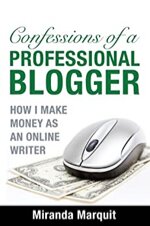 Confessions of a Professional Blogger: How I Make Money as an Online Writer: The rise of blogging and other forms of online writing provides new opportunities for writers of all skill levels to create location-independent careers. Confessions of a Professional Blogger offers a straightforward approach to becoming an Internet freelancer. This book pulls no punches, telling the truth about what it takes to successfully build a freelance business with online writing.
Miranda Marquit has a M.A. in journalism and is a successful professional blogger and freelancer writer. Her insights, gained from years working on the Web (from the comfort of her home), can help you:
• Get paid what you’re worth as a writer
• Land better gigs with more exposure
• Identify the best places to find jobs
• Build your own writing empire
• Improve your writing skills
• Find your area of expertise
• Expand your online boundaries
• Manage your business on a variable income
Available on Amazon.