


The Best Writing Career Results From Combining Your Skills
by Sarah Walker
As I suspect is the case for the vast majority of writers, I started out with unpaid features…but I did have a helping hand: an agent!
At the time (2005), I was presenting a couple of property programs for the BBC, so my first foray into print was writing Q&A columns and features under that banner, more for PR than anything else.
The first time I got paid for my writing was towards the end of 2007. The job: pretending to be a gay man!
I’d met the editor of “Gay Times” magazine at a party and one of his regular writers had just let him down, so he needed someone to ghostwrite a property page for the owner of a London sales & lettings agency. (A guy who’d gained some notoriety by being a Big Brother housemate a few years earlier.)
That became a regular monthly assignment for 18 months. At the same time, I was working on PR articles, web content and marketing materials for a friend’s start-up property investment franchise – the “day job.”
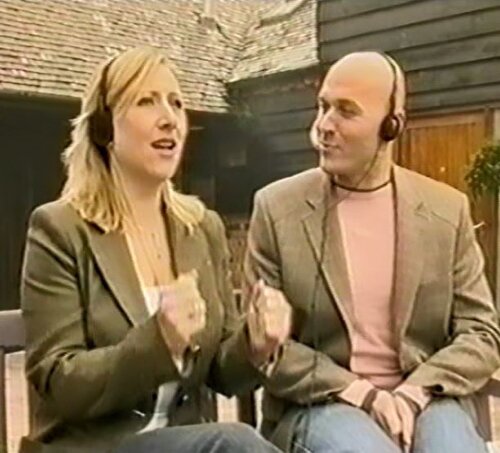
“To Buy Or Not To Buy,” BBC1, 2006.
In Writing, It Helps to Be In the Right Place at the Right Time
During that time, I was also giving talks at property shows and conferences, and met an independent UK property market analyst. She liked what I was saying and asked if I would be interested in working with her on various commercial writing projects, as her editor.
We’ve worked together ever since – for more than 10 years now – with her gaining contracts to produce content for various businesses and professional organizations within the industry, and me either writing the content or editing for her.
So, I suppose I got started on my writing & editing career simply by being in the right place at the right time!
How I Found My Writing Niche—Which I’m Now Trying to Escape!
I’ve been involved in property, in one form or another, for over 20 years.
In the late ’90s and early ’00s, I was an estate agent, then presented property shows on television for almost four years. When that came to an end, I began working for a friend’s start-up property investment company, taking on the PR & Marketing role and speaking at various property, franchise and business investment shows around the UK.
I also invested in buy-to-let property myself and, through networking and word of mouth, began to get writing assignments for industry magazines and websites. Then, because of my understanding and personal experience of the UK buy-to-let market, some of the entrepreneurs already in my business circle asked if I would ghostwrite books for them.
Obviously, when it’s your bread & butter, you can’t just walk away from a specialism, but I am ready for a change. I’ve worked on books aimed at small and medium-sized businesses and also marketing, which I find a bit more interesting, but I’d love to have a bash at someone’s biography.
Networking Doesn’t Have to Be Hard Work
The truth is, I’ve been pretty lucky so far and haven’t had to put much effort into marketing myself. The vast majority of my work has come to me either through word of mouth or because I’ve happened to meet people socially who’ve then contacted me to help them with their business in some way.
I think that’s a really important point to make: never underestimate the value of networking.
And it doesn’t have to be hard work – you don’t need to keep running off to “business breakfasts” or organized industry events – you can achieve a lot simply by engaging well with people you meet socially or through your day-to-day business.
I also have a paid-for listing on journalism.co.uk. Even if I only get one or two jobs a year, that still makes it well worth the investment.
And then, of course, there’s social media and my website, which neatly snapshots my CV and services, gives me a decent Google presence, and certainly delivers clients. The chap I’m currently ghostwriting a book for found me a couple of years ago just by searching online and I’ve been writing for him and his business ever since.
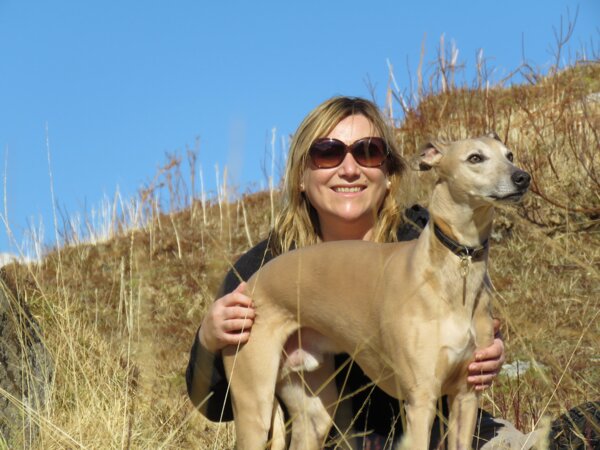
Sarah & Ledi.
Why Having Other Skills Is Important to Your Writing Business
Having other skills on top of writing and therefore being able to provide a more complete service has definitely helped me – for instance, being able to design and administer websites for clients, help them put together marketing materials and guiding them through the self-publishing process.
So I always make a conscious effort to offer additional and/or ongoing services. An old school friend and her husband recently asked me to help bring their business blog up to date. While I was putting together some backdated content, I also investigated their Facebook page and then suggested an ongoing marketing plan, which has now become another regular monthly job for me.
As most people reading this will know, freelance writing is a very much the kind of business where there are no buses, then they all come at once…and so on. It can be feast or famine and I do struggle in the quieter times.
And it’s a balancing act, because you need enough regular work to pay the bills every month, but then also have to keep room for bigger projects. I guess that’s why I’ve diversified – the more strings you have to your bow, the greater chance you have of picking up even small jobs to help you through when there’s not so much of your ideal work around. Plus, you never know where things will lead…!

Speaking at Liverpool Landlord Show, Sept 2010.
Why I Try to Have at Least One Bigger, Longer-Term Project Going
In terms of the highest hourly or daily rate, smaller jobs are best, as it’s just a straightforward charge for every hour or day worked. But those jobs tend to be either one offs or just one or two days each month.
For instance, one of my regular monthly jobs is writing a landlord newsletter for a national estate agent, but that only takes a day and a half. The ideal situation would be having that kind of work three days a week – I’d be very happy with that.
But it is a struggle to keep finding those individual jobs so, to take up the slack, I try to have at least one bigger, longer-term project on the go at the same time. Even though the daily rate is lower, the greater number of days’ work makes up for it.
And, for me, that work is usually either ghostwriting or editing books.
The 3 Biggest Challenges of Ghostwriting a Book
Number one on the list is definitely the “author!”
To date, I’ve worked with fairly successful entrepreneurs, who tend to be permanently buzzing with ideas and aren’t afraid to change direction and focus, which can be a bit frustrating. As well as changing their mind about exactly what they want, they can also get distracted by one of their many other projects, so timescales can go to pot.
Sometimes they’re brilliant and will get back to me with amendments to a draft within a fortnight; other times there can be a gap of a couple of months, while something else takes priority.
So, although you will agree a timescale at the start with clear deadlines, prepare to be flexible.
That leads on to the second challenge: managing payments and making sure your income is as consistent as possible.
The first time I wrote a book, I made the mistake of not setting out payment terms at the start and had to wait until it was finished before invoicing. If you’re living month to month, it’s virtually impossible to commit the required hours over a six-month plus period without getting paid for it during that time.
So, now I give the client an initial quote based on the expected number days’ work and then ask for stage payments, which usually works out around 40% up front, 40% on submission of the first draft and the balance when it’s signed off and ready to print.
Finally, there’s managing the workload over an extended period of time.
I am a champion procrastinator, so having a deadline that’s relatively far off is a killer for me! And, unfortunately, I do work better under pressure so, even when I impose lots of mini deadlines, if there’s no big negative consequence to not meeting them, they tend to fall by the wayside and that means a lot of long days and late nights towards the end!
Challenges aside, I would certainly recommend ghostwriting books as a good thing for every writer to do.
Usually, if someone wants a book written for them, they’ve got the money to spend and know the value of people’s time, so rarely quibble on price. (I may start putting my rate up!) It also gives you the opportunity to practice the book-writing process while earning.
People often ask me why I don’t write a book of my own instead of always doing it for other people. My response: “Well, firstly you need a good idea and, secondly, unless you’ve got a publishing deal, nobody pays you to write your own book!” So, until I land on a brilliant concept, I shall keep ghostwriting and enjoy the edit credit (as it usually ends up) and the satisfaction of seeing the finished book on the shelf.
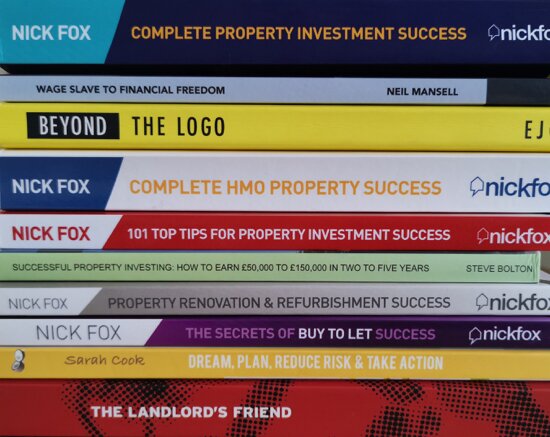
Ghostwritten & edited books.
In Front of the Camera and Behind the Microphone: Corporate Films
As I mentioned at the start, before I became a writer, I had a 4-year stint presenting property programs for the BBC.
As well as loving being in front of the camera, I also really enjoyed the post-production element of voiceovers. And, funnily, it was often my voice rather than my face that got recognized by people.
So, when I then moved into the more corporate world of property and start-up businesses, I was periodically asked to conduct interviews, do voiceovers and even direct and produce the odd short film.
The voiceovers were relatively straightforward – I was emailed a script, then headed to either a formal recording studio or, more often, a freelance camera or sound engineer’s house, to record the voice track. Sometimes there was an accompanying video, sometimes it was just as case of reading the script as a “standalone.”
One of the strangest in-vision video experiences I had was recording a training video for Bunzl, where I had to speak in front of a green screen, imagine the images behind and in front of me and swipe invisible buttons!
And one of the most rewarding projects was a promo video for The Property Investor Show in London, for which I wrote the script, planned the content, conducted interviews, guided the cameraman and then worked with an editor to stitch it all together. I also worked as the editor on a series of information videos for the national insurance company, Direct Line.
Again, all those opportunities came about simply by meeting people at events and through existing business contacts. Two golden rules in the freelance world: be nice to people and get a reputation for being reliable.

Bunzl corporate training film.
My 5 Tips for Writers and Editors Starting Out
1. Try to write about things you either know a lot about or are genuinely interested in.
It can take a long time to get a piece of writing right and if you don’t really understand or care about the content, it’ll be a real grind.
2. Sticking point 1 to one side, give anything and everything a go!
Even if it’s something you haven’t tried before, you’ll work it out and there’s a huge amount of information and help online. While I was writing the property page for an airline magazine, they asked if I could produce a feature on tenders for superyachts. Yep!
3. Make sure you know the target market for your writing and have a clear tone of voice.
This is particularly important if you’re ghostwriting. One of my regular jobs is producing a newsletter that has to be written in the right tone of voice for one branch of the client’s customer base, then rewritten in a different tone for a different type of customer. The basic content is the same, but the syntax is completely different. So try to hear a voice in your head while you’re writing.
4. If you’re not feeling it, take a break.
It might sound precious, but I have days where I don’t feel in the least bit creative and I know it’s pointless sitting down to write because I won’t produce anything worthwhile. So go out for a walk, do some exercise, go to the supermarket – just have a change of scenery and don’t torture yourself. Nine times out of ten, I actually have bolts of inspiration while I’m off doing something else and I have to scurry back to the laptop to get it down before I forget!
5. Never submit a piece of work unless you know you’ve fulfilled the brief and you truly believe it’s ready to print.
Read it, re-read it, walk away for a few hours and read it again. Then read it out loud – you’ll be amazed how many things you pick up. And pay particular attention to the word count. A huge bug-bear of magazine editors is getting copy from writers that’s too long and needs a lot of editing, so make sure you get a reputation for quality.
* * *
 Following early careers in estate agency and television presenting—and finally putting her English degree to good use!—Sarah Walker began writing for property and lifestyle magazines in 2005. Since then, she has continued to write for industry publications and has produced a wide range of marketing and PR content for leading UK property companies.
In recent years, she has worked closely with a number of entrepreneurs, ghostwriting and editing books that support their business enterprises. She also creates content for, designs and administers websites on behalf of individuals and small businesses.
Away from the laptop, Sarah is a keen amateur photographer and loves nothing more than jumping in the car with her camera and her trusty whippet and heading out into the glorious Scottish countryside.
For more about Sarah and her work, please see her website, blog, and photography site, and connect with her on Instagram and Twitter.