


Tips and Tools to Help Writers Boost Their Businesses
by Elizabeth Ducie
Before I became a “full-time” writer, I worked for more than thirty years in the pharmaceutical manufacturing industry; and for most of that time, I was self-employed.
Without the benefit of a regular monthly wage packet, I needed to expand my portfolio of projects and responded to an advert for a manufacturing expert to write a Management Report (one of those highly expensive, A4 flexi-covered volumes that no individual ever buys, but can be found on library and industry shelves).
Ten years and three editions later, I realized that while I would never make a fortune as a writer, it was a process I enjoyed and one I wanted to continue with.
Before I left the industry, I also wrote a couple of hard-backed text books. And for a few years, I was editor for a technical journal. That was actually an unpaid position, but it made me lots of contacts in the industry, so was a useful marketing tool.
And I got great pleasure from reducing a non-writer’s 2,500 rambling words into a well-crafted article of 1,800 words.
Real Incidences Find Their Way Into My Fiction
For many years, I was working internationally. I visited more than fifty countries; and worked with both governments (to write the regulations) and industry (to interpret the regulations). I gathered many anecdotes and experiences that I use to inform my fiction.
Many of my short stories and all four of my novels are set primarily outside the UK; and while they are all fictional, there are many real incidents that find their way in there. I originally thought I was going to focus on life writing, but have found I’m much happier putting real nuggets into fictional settings.
Many of the reviews for my novels comment on the fact that I can make a setting come alive and transport the reader to a foreign country.

Elizabeth (left) helping the production staff to make their drugs safely, in a small factory in Kursk, Southern Russia. This factory makes an appearance in one of her thrillers.
Running a Business is a Means to an End, Not An End in Itself
In terms of my non-fiction, I have always believed in keeping things simple and understanding the basic minimum standards that need to be achieved. This is an approach we used all the time in the pharmaceutical world.
Most of my clients were in under-developed countries where finances were very tight and the bells and whistles so beloved of the Western companies and regulators were unnecessary luxuries.
I take the same approach with my business books. Running a business is a means to an end, not an end in itself. Writers want to be writing, not setting up elaborate business plans or inputting data to complex computerized financial systems.
I identify what they MUST do and differentiate it from what they COULD do if they had more time and/or money.
How I Got Into Writing Business Books for Writers
[Getting into writing business books for writers] was a gradual process. I have been a regular attendee at the Writers’ Summer School at Swanwick since 2006. During my first visit there, I spent a lot of time apologizing for not being a published author, equating “author” with “novelist.”It was a wonderful tutor and storyteller, the late Brendan Nolan, who pointed out that with three text books to my name, I was already a proper author; and that not all authors write fiction!
I have been running my own small business since 1992, and am happy and confident around spreadsheets, finance systems and project plans. I quickly realized not all writers were so inclined; although most them qualified for the term “small business owner.”
I began presenting workshops on The Business of Writing at Swanwick and still do most years. My scripts migrated first to blog posts; and then into a series of three ebooks. The ebooks were too small to convert to paperbacks, so I put them all together in one volume.
I am now on to my second edition, as business advice needs updating periodically, and have added a workbook to the series, for people who want to work through the process themselves.
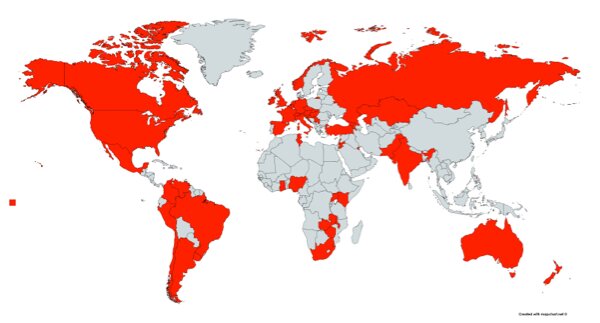
A map of the world, with the countries Elizabeth has worked in colored red.
I Hope to Make the Self-Publishing Journey Easier for Others
I have been independently publishing since 2011 and passionately believe the indie route is a legitimate option for writers, rather than the final resort for someone who has “failed” to get a traditional deal.
Having worked my way through the early years of this process, I now feel very confident about passing on tips to others following me down the path.
And that’s how the latest book in The Business of Writing series came about. There are so many pitfalls along the way, many of which I have stumbled into at one time or another; my aim is to make the journey just a little bit easier for others.
The Biggest Mistake Writers Make
I suspect the biggest mistake writers make is NOT looking at their work as a business. Or falling into the “carrier bag” syndrome where all the paperwork is pushed to one side and then presented to an accountant in a carrier bag at the end of the year.
A couple of hours every month, devoted to keeping the administration up to date should be all it takes to keep on top of the system; and it’s much easier and cheaper to sort it out at year end that way too.
Things Writers Need to Know About Finances that They Often Don’t
If a writer is “giving up the day job” in order to writer full-time, they have to take a long, hard – and realistic – look at their finances.
Very few authors make a living out of writing alone. And if they do, it usually takes a fair time to happen. So there needs to be other sources of finance available – whether that’s savings, a part-time job, writerly activities like training or such like – to tide them over.
If writing is a business, then it will require investment to get it going. And whether that is investment in technology; or investment of time and money in promotion; or investment in some training; it needs to be factored in to the equation. So it’s not just a case of finances for paying regular bills, but also investment finance that needs to be considered.
A carefully prepared and conservative cash flow analysis covering a couple of years is something anyone starting a new business needs to prepare. And in that respect, writing is a business like any other.
Suggestions to Help Self-Publishers Improve Their Businesses
I would suggest using the term independent publisher, rather than self-publisher, because the latter implies the writer does everything themselves, which is not necessary, or even desirable in many cases. Using the correct terminology creates a different mind-set. It’s about who has responsibility, rather than who carries out the tasks.
Whether a book is independently or traditionally published, there should be no difference in the end product. It should be properly edited and proofread; professionally laid out; and with a stunning cover that tells the reader immediately the genre of the book.
The only difference between the two is that in the former case, the writer is responsible for ensuring that everything is done, whereas in the latter case, the publisher will take much of the responsibility away. I have no artistic talent at all. I would never consider designing my fiction covers myself. But I am responsible for ensuring that I employ a great designer who “gets” my book and understands what I want the cover to portray.
So my second piece of advice would be to take a good look at the skills the writer has themselves, and identify which need to be bought in.
And do not be tempted to cut corners! Building up a reputation as a good and professional writer takes time. And first impressions really do count. A badly finished book causes a bad impression and is very difficult to overcome.
My Book “Improving Effectiveness:” The Main Focus
This is another case of my bringing my pre-writing life experiences to bear.
I was a project manager; I was very keen on time management; and I needed to be able to work for multiple clients, on multiple projects at the same time.
As a writer, I find myself frequently running up against deadlines and, just occasionally, getting overwhelmed by all the things I have to do. And I know I’m not alone in that.
So having dealt in the first two parts of the series with the steps needed to set up a business; and with a more detailed investigation of finance systems; the third book, Improving Effectiveness, was a mixed bag of tools, techniques and tips that I have found useful over the years. It is aimed at helping the writer to be kind to themselves.
Advice for a Young Writer: Make Sure You Have a Way of Keeping Yourself
As I said earlier, it’s quite rare for a writer to make a living just from writing. So I would tell them to make sure they had a way of keeping themselves in the meantime. Whether that’s by having a career in a totally different field, as I did; or taking a job in the literary world, there are lots of options out there.
But I would also tell them to keep writing, keep practicing, and keep dreaming. Being a writer is a very satisfying occupation. I may have come to it late, but I’m having a whale of a time.
* * *

SONY DSC
Elizabeth Ducie lives in a small town in Devon and these days she seldom travels further than Exeter; she finds going to London a big deal; and she rarely goes anywhere near an airport. But it wasn’t always like that. She spent 30+ years working in international pharmacueticals and during that time, wrote millions of words, all of them technical.
After a health scare in 2005, she started writing fiction and creative non-fiction; and in 2012, she gave up the day job to write “full-time”; when she isn’t sitting on committees, attending meetings, playing Mah Jong or taking part in the myriad facets of rural life in the South West.
She is a Trustee for Cancer Lifeline South West and Director of the Exeter Literary Festival 2020. She has published four novels and three collections of short stories in addition to her series on The Business of Writing.
For more information about Elizabeth and her work, please see her website, or connect with her on Facebook and Twitter.
 The Business of Writing Parts 1-3: The Business of Writing series aims to provide a simple route by which writers can set up and run their own small businesses.
It identifies the “basic minimum standards” that must be achieved, while freeing the writer to spend the maximum possible time writing.
Part 1 deals with setting up a business; Part 2 cover finance systems; and Part 3 is aimed at improving effectiveness.
Available at Amazon.
 The Business of Writing Part 4 Independent Publishing: The Business of Writing Part 4 Independent Publishing walks you through the questions you need to ask and helps you find the answers:
Is indie publishing the right route for me? Which formats do I need for my books? Should I choose Amazon exclusivity or ‘go wide’?
And much more…
Available at Amazon.