


What Happened When This Professor Left Academia to Write Full Time
by Lev Raphael
I come from a family of teachers and always wanted to teach as well as write.
In college I was lucky enough to have two professors who let me sit in on their classes and observe what they did, and we would discuss their pedagogy afterwards.
I saw how much work went into teaching because they took me behind the curtain. Thanks to those two profs, I taught my first ESL (English as a Second Language) class when I was only 21.
And because I was taking theater classes and appearing in plays as well while majoring in English, I came to understand that teaching was a performance. Which in turn later on helped me on many book tours when I did readings.
My Writing Career Started with a Literary Prize
I won a literary prize in my MFA program and the judge was a famous editor, which helped that story get published in “Redbook.” At the time it had 4.5 million readers and I made a lot of money, got my first fan mail and queries from agents.
That story started my career, which promptly stalled because I couldn’t get anything published for five years after that. But when the logjam broke, I was paid for almost every story I published, even nominally, and rarely settled for what everyone talks about now: “exposure.”
Pursuing both careers, I taught full-time for a few years after my PhD and also worked hard trying to get a book published. I eventually left academia so that I could devote myself 100% to getting a book sold—it worked.
I’ve done writing workshops of all kinds since then and just finished a six-year stint as a visiting assistant professor of creative writing at Michigan State University before launching on-line workshops at writewithoutborders.com.
My Niche: I Started Writing Short Stories…and Then Drifted
In general you could say I teach fiction and creative nonfiction and have been since I began.
Going deeper, I’ve published in a dozen different genres so I’d say I have many niches. I am not a genre snob at all—I’ve published horror and erotica and literary fiction and I love them all. I’ve also published hundreds of book reviews and blogs so I understand structuring pieces even smaller than short stories. That’s the genre I started out in—and then I drifted.
When I was a kid, nobody told me what to read or what not to read so I read all kinds of fiction, humor, history, biographies, anything that told a great story. That’s what I look for in a book: a compelling narrative told in prose that grabs me. And that’s what I try to help my students create. My goal is to assist them in developing their gifts and polishing what they need to know to go to the next level in their writing.
When I teach, I draw on examples from across the board and I do deep dives into my students’ work: everything is on the table.
And my college creative writing mentor is always by my side or in my head: when I’m not sure how to help a writer, I just ask “What would Dr. Lauer say?” and it invariably works.
How I Market Myself: Website, Social Media, Facebook Ads, and Writer’s Conferences
Business speeds up, slows down, business is unpredictable. I just roll with it.
I had a clear, easy-to-navigate, inviting website designed just for my teaching: writewithoutborders.com. And for years I’ve made sure that my author web site is updated as often as necessary. Fans need to know what I’m up to, where I’m speaking or reading–ditto editors, publicists, and people who might be thinking about buying my books or inviting me to speak at their venue.
I maintain a presence on Facebook and Twitter, and blog pretty much every week about some aspect of writing or publishing via my author website. I cross-post those blogs. I also run ads on Facebook which sometimes help and sometimes don’t, but it’s not a huge outlay, and it’s probably too soon to tell overall how effective they are.
I do lots of writers’ conferences and always bring flyers for my workshop, books to sell, and have eye-catching table signs, as well as plenty of business cards. As someone who publishes crime fiction and reviewed it for years, I subscribe to the mystery fans listserv called DorothyL.
My Most Lucrative Book is a Children’s Book!
My most lucrative assignment: This is where I’m a bit of an outlier. My most lucrative book is Stick Up For Yourself! It’s a kids’ self-esteem book that’s sold close to 300,000 copies and been translated into over a dozen languages. It actually was assigned by a publisher who wanted an adaptation of a book for adults that I had co-authored.
My next most successful book, financially, is My Germany, a memoir/travelogue focusing on my life as the son of Holocaust survivors whose life was changed by book tours in Germany. I did over fifty gigs for it, many of them well-paid, and that included two book tours in Germany sponsored by the U.S. State Department. I did readings in English and German. It was all exhilarating!
I’ve done blog tours and find that live tours are much more effective. There’s nothing like talking about your work in person, reading it and doing Q&A to get people interested. My college background in theater and my years of teaching have helped me prepare for being comfortable with an audience.
I also offer personalized workshops as well as editing from micro to macro—that is, line editing all the way through to structure. My workshop limit is 10 participants and I’m also always available to work with writers individually in any genre on any sort of project, which includes full manuscripts. One writer is working on a memoir in stages, another working on a connected series of short stories.
What Makes My Writing Life Easier
Having someone update my websites is crucial. I’m regularly in touch with her for updating my calendar, implementing design changes, adding new pages, and for anything to make the site more informative, attractive, and current.
I tweet on #WriterWednesday nearly every week and cross-post on my Facebook author page and my workshop page. I use Tweetdeck to set tweets up in advance. I rarely sell or advertise directly—I use Twitter to post blogs and there are links in my signature line or the blog itself. #SundayBlogShare, #MondayBlogs, and #TravelTuesday are other favorites for me.
What I Need Instead of Motivation as a Writer
I started writing fiction in second grade because I fell in love with storytelling. I am living my dream. I’ve had my disappointments the way most writers do, but I’ve always been in love with turning the world into words.
It also helps that I read broadly and find inspiration from so many different kinds of writers, including screen writers and writers for TV. I study dialogue, scene building, plot, the works.
So I actually don’t need motivation, I need more time to get all the projects I have in mind done. I don’t type very fast at all, so I could use an android like the ones on the British show Humans to assist me. Maybe a pair of them….
Advice for a Young Writer: Be Stubborn and Work Hard
You need to be stubborn, you need to work hard, you need to educate yourself about the craft and the business. And you definitely need to read outside your chosen genre(s) to broaden your frame of reference.
There’s more competition now than ever before. I’d suggest having an anchor in a job that pays a living wage until your writing earns you enough to give it up—which might never happen. Be prepared. If you love writing it shouldn’t matter.
Next, start to build your platform through YouTube or Instagram if you can, or a dynamic website—or all three. If you have an original idea for a blog or vlog, try it out and build an audience that way.
Something else to consider is location—where do you live? Yes, we all have access to the Internet, but personal access, schmoozing and networking don’t just happen at conferences, they happen in cities like New York where publishers, editors, writers, and media are heavily concentrated. Connections really make a difference.
I also think young writers might want to consider picking just one genre and staying with it to get established—it helps editors, reviewers, readers place you and follow you better—not to mention booksellers and anyone who’s marketing you.
That hasn’t been my path even though I do have a mystery series, but then I came up in publishing when the terrain was very different.
And then I’d suggest that young writers need to consider their lives as a whole. I recommend having as many friends as possible who don’t write so that you’re not always involved in shop talk. Writers also need to be physical so that they can get out of their heads: swimming, running, yoga, biking, weight lifting, Pilates, racquetball—whatever works.
On top of that, writers need interests that aren’t directly related to writing, and that includes any kind of hobby. I take voice lessons in part because it’s good to feel like a student and I love music. I travel whenever I can, here and abroad. I know French and German but I’ve studied other languages like Swedish and that’s a lot of fun. I’m a major movie buff and also binge watch shows on a regular basis.
Finally, I like the advice that Henry James gave to a young writer: “Try to be one of the people on whom nothing is lost!” Be open to every possibility life presents you because that will make you a better writer.
* * *
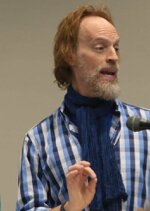 Lev Raphael is the author and co-author of 26 books in a dozen genres from memoir to mystery. His first book of short stories Dancing on Tisha B’Av won a Lambda Literary Award. He’s published hundreds of stories, essays, articles, and book reviews in a wide range of newspapers, magazines, and journals. His fiction and essays have appeared in over 24 anthologies in the U.S. and England, and are taught at colleges and universities around the country–which mean he’s become homework. His fiction has been analyzed in scholarly journals and books, and at conferences like MLA.
Raphael was a long-time reviewer for the Detroit Free Press, The Washington Post and other papers. He also reviewed on several public radio stations and hosted his own book show whose guests included Salman Rushdie. Michigan State University’s Special Collections purchased his literary papers in 2009 and updates “The Lev Raphael Papers” yearly.
For more information on Lev and his work, please see his website or his writing workshop site, or connect with him on Twitter, Facebook, and YouTube.
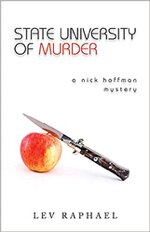 State University of Murder: Still reeling from having escaped a mass shooting on campus, English professor Nick Hoffman finds himself on the receiving end of confessions by one colleague after another.
All of them have good reason to hate the new department chair, Dr. Napoleon Padovani, who throws his weight around capriciously and cruelly. Resentment mounts on campus—with an inevitably fatal result. Chaos and confusion reign among the faculty, which then turns on its own.
Can Nick and his spouse Stefan restore order and save the day?
Available at Amazon, Barnes & Noble, and IndieBound.